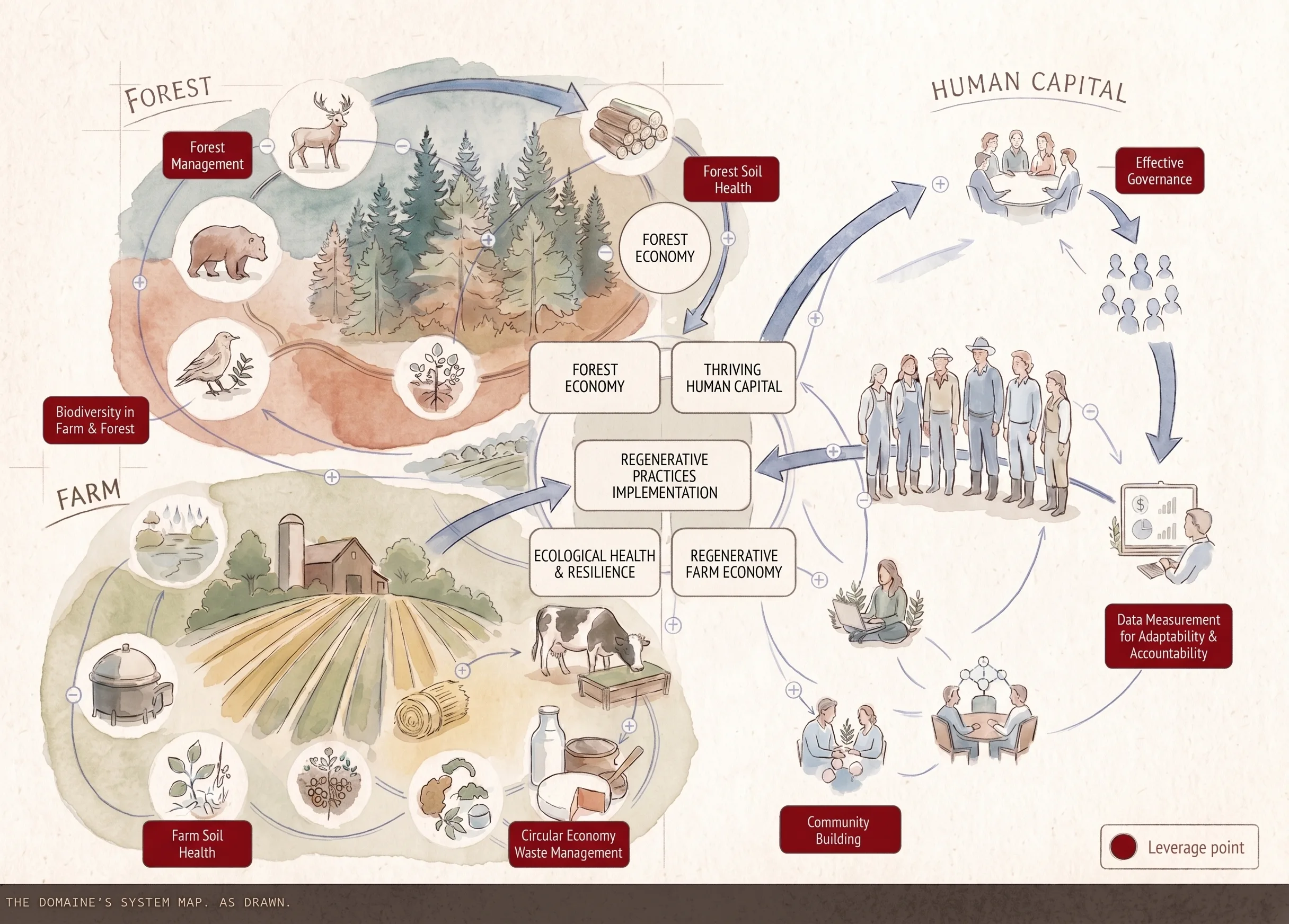

Manifesto for Systemic Regeneration
A doctrinal treatise for leaving the regime of optimization
Preamble
We live in a world that has learned to measure its damage faster than it has learned to repair it. It knows how to count carbon, classify risks, produce reports, rank indicators, hand out ratings, certify trajectories. It knows how to name what is degrading. It even knows, at times, how to name it with precision. Yet it remains the prisoner of a deeper contradiction: it is trying to render sustainable a model whose central imaginary remains expansion, performance, acceleration, and optimization.
Systemic regeneration is born of this impasse. It does not denote a new layer of managerial vocabulary. It does not consist in repainting the existing economy green. It affirms that the historical task is no longer merely to reduce negative impacts, but to re-establish the conditions of possibility for life itself: soils, waters, biogeochemical cycles, biodiversity, social trust, local institutions, situated productive capacities, long-form knowledge, the commons, the dignity of labour, the autonomy of territories.
It is therefore not a supplement of soul added to ESG. It is a change of grammar.
1. The current system: the ESG world, or the efficient administration of the unsustainable
The contemporary world of ESG was born of a sound intuition: the economy can no longer claim to ignore its externalities. Environmental, social, and governance impacts therefore had to be made visible; the firm had to be compelled to see itself no longer merely as a machine for producing financial value, but as a node of effects, dependencies, and responsibilities. The rise of the European CSRD and of the principle of double materiality expresses this shift: companies must henceforth account both for the way sustainability issues affect their financial situation and for the way their activities affect people and the environment.
But this advance carries a constitutive ambiguity. ESG widens the perimeter of reporting without necessarily transforming the regime of ends. It brings the living world into the firm’s dashboards, but it risks converting the ecological crisis into a problem of compliance, reputation, rating, and risk management. Where regeneration demands a transformation of economic metabolisms, ESG may confine itself to a transformation of the formats of proof. It does not always ask: “What activity must cease? What need must be requalified? What territory must be repaired? What temporality must be respected?” It more often asks: “Which indicator should we track? Which trajectory should we declare? Which risk should we keep under control?”
That is where the paradox lies: we are trying to sustain a world of tendentially infinite growth within a world of finite resources. The UNEP Global Resources Outlook 2024 reminds us that global resource use rose from roughly 30 billion tonnes in 1970 to 106 billion tonnes, and that the extraction and processing of resources account for more than 60% of warming-related emissions and around 40% of the health impacts linked to air pollution. The update to the planetary boundaries framework, published in 2023 and synthesized by the Stockholm Resilience Centre, already indicated that six of the nine planetary boundaries had been crossed. The decisive fact, then, is not merely that we pollute too much; it is that our systems of production, consumption, finance, mobility, food, and urbanization are consuming the very material bases of their own continuity.
In this context, ESG functions as an attempt to make the incompatible compatible: to pursue efficiency, productivity, growth in volumes, and the fluidity of global chains, while correcting the destructive effects of that very pursuit. This is a world of global optimization: optimization of costs, flows, stocks, lead times, yields, assets, data, uses, human resources. The dominant vocabulary is that of performance: produce more with less, reduce frictions, eliminate redundancies, accelerate returns, integrate risks, maximize synergies.
Yet optimization has a dark side: it often eliminates the very margins that allow systems to hold. Stock becomes waste, redundancy becomes cost, slowness becomes inefficiency, diversity becomes needless complexity, the local becomes archaism, repair becomes less profitable than replacement. The high-performing system is therefore often a fragile one. It may excel in a stable environment, but it is brutally exposed when conditions fluctuate: energy crisis, pandemic, drought, logistical rupture, geopolitical conflict, financial volatility, the scarcity of a resource, the collapse of an ecosystem.
To this is added a difficulty proper to ESG: measurement is not stabilized within it. The now-classic study by Berg, Kölbel, and Rigobon on the divergence of ESG ratings shows that rating agencies evaluate companies according to strongly heterogeneous methodologies, with divergences tied to the scope, the measurement, and the weighting of criteria. This finding does not invalidate ESG, but it reveals its limit: when sustainability becomes a rating, it enters an economy of commensurability that can mask substantive conflicts. Two companies may be compared without our really knowing whether they contribute to restoring the conditions of life or only to reducing certain visible risks.
The decoupling of economic growth from resource use and emissions constitutes the doctrinal core of this promise. The dominant thesis holds that it would be possible to keep growing GDP while reducing ecological pressures sufficiently. Forms of relative decoupling do exist, and certain cases of absolute decoupling at the sectoral or territorial level must be taken seriously. But the systematic reviews stress that evidence of absolute decoupling at the scale, speed, and magnitude required remains rare and scattered. It is here that the ESG regime reaches its point of maximum tension: it seeks to correct the impacts of the model without always interrogating the model of desire, production, and accumulation that generates them.
The ESG world is therefore not to be dismissed as mere simulacrum. It constitutes a useful infrastructure of visibility, discipline, and accountability. It compels economic actors to document what they would prefer to keep off-screen. It creates obligations, data, comparisons, and sometimes sanctions. But it remains insufficient as long as it stays captive to the very paradigm it claims to regulate. It administers the unsustainable instead of refounding the sustainable. It perfects the cockpit while the trajectory itself remains problematic.
The first thesis of this manifesto is therefore the following: ESG is necessary as a transitional language of accountability, but it is insufficient as a doctrine of transformation. It measures; it does not regenerate. It optimizes; it does not necessarily reorient. It sometimes reduces harm; it does not always restore the conditions of living well.
2. Regenerative thought: from performance to robustness, from least harm to the power of life
Regenerative thought sets out from a more radical proposition than that of classical sustainable development. It is no longer merely a matter of “doing less harm,” of lowering emissions, reducing waste, making buildings more efficient, offsetting impacts, or optimizing consumption. It is a matter of designing human systems capable of contributing to the health of the living systems on which they depend. Pamela Mang and Bill Reed define regenerative development as an evolution of the sustainability paradigm: where green approaches seek above all to minimize damage and use resources more efficiently, the regenerative approach aims at a deeper systemic integration, in which human and natural systems co-evolve while producing mutual benefits.
Regeneration is therefore not to be confused with conservation. To conserve is to preserve a state. To restore is to repair a degraded state. To regenerate is to reactivate a capacity: the capacity of a soil to remake fertility, of a watershed to retain and filter water, of a territory to feed its inhabitants, of a community to resolve its conflicts, of an organization to learn, of an economy to maintain its material cycles within limits compatible with the living.
It is here that Olivier Hamant supplies a decisive doctrinal piece: the critique of the cult of performance and the rehabilitation of robustness. In La Troisième voie du vivant (The Third Way of the Living), he draws on the life sciences to contest the modern self-evidence according to which maximal efficiency would always be desirable. He reminds us that the living is not made of optimization alone; it is also made of slownesses, errors, redundancies, apparent incoherences, sub-optimalities that contribute to its robustness. In Antidote au culte de la performance (Antidote to the Cult of Performance), he characterizes our civilization as a civilization of generalized optimization, obsessed with efficacy and efficiency.
Robustness, in this perspective, is not rigid resistance. It is the capacity to maintain viability amid fluctuation. Hamant distinguishes it from performance: performance consists in attaining an objective with the fewest possible means; robustness presupposes, on the contrary, fallback options, redundancy, a diversity of options, experimentation, paths off the main road. This idea is central: in a stable world, optimization may appear rational; in a fluctuating world, it becomes a source of vulnerability. Robustness is not the enemy of intelligence; it is the intelligence of unstable worlds.
The life sciences confirm this intuition. Hiroaki Kitano defines biological robustness as a fundamental property of living and evolving systems, but he also underscores the trade-offs among robustness, fragility, performance, and resource demand. In other words, robustness is not free: it presupposes redundancies, feedback loops, modular architectures, dormant capacities, forms of functional diversity. It costs in the short term, but it averts collapse in the long term. This is precisely what the world of performance is unable to evaluate: the value of that which serves no purpose so long as all is well.
Ecological resilience, since the founding work of C. S. Holling in 1973, has likewise shifted the understanding of living systems: an ecosystem is defined not solely by its stability around an equilibrium, but by its capacity to absorb disturbances, to change without losing its functional identity, to cross thresholds without tipping into a degraded regime. The Stockholm Resilience Centre sums up this approach through principles that bear directly on regeneration: maintain diversity and redundancy, manage connectivity, attend to slow variables and feedbacks, foster learning and adaptive governance.
Regeneration applies these principles to three inseparable planes.
The first is biological and ecological. To regenerate is to restore soils, ecological continuities, water cycles, biodiversity, habitats, ecosystem functions. This presupposes moving beyond an extractive vision of the living as a stock of resources and into a metabolic vision: the soil is not a substrate but a living community; water is not a flow to be channelled but a cycle to be husbanded; biodiversity is not a backdrop but an infrastructure of stability; carbon is not merely a tonne to be offset but an element inscribed within territorial, agricultural, forest, oceanic, and industrial cycles.
The second plane is social. A regenerative society does not content itself with greening its production; it restores its collective capacities. It rebuilds trust, the commons, know-how, deliberation, cooperation, institutions of proximity, the trades of maintenance, the networks of care, the capacities for mutual aid. It understands that social robustness depends on the diversity of skills, the quality of bonds, the density of intermediary institutions, the capacity to learn from conflict. A hyper-performing society may be socially impoverished: fast, efficient, connected, yet incapable of caring for its own vulnerabilities.
The third plane is economic. A regenerative economy asks not only whether an activity is profitable, but whether it increases or diminishes the renewal capacities of the system that makes it possible. It measures not only the productivity of labour, but also the productivity of cycles, reparability, durability, modularity, pertinent relocalization, material sobriety, the quality of interdependencies. The work on Doughnut economics by Kate Raworth and Andrew Fanning formulates this requirement as the search for a safe and just space: meeting fundamental human needs without overshooting ecological ceilings. Their analysis published in Nature in 2025 shows that between 2000 and 2022 the growth of global GDP was accompanied by insufficient social progress and a worsening of ecological overshoot, which supports the case for a reorientation towards regenerative and distributive activities.
Regenerative economics here converges with certain proposals of John Fullerton on regenerative economics: to regard the economy as a living system, embedded in relationships, dependent on the health of its parts and of its whole, oriented towards long-term vitality rather than short-term value extraction. This approach remains debatable in its most analogical formulations, but it has the merit of displacing the economic question: an economy should not merely produce goods; it should reproduce the conditions of its own habitability.
A serious objection must, however, be raised. Regeneration may in its turn become a portmanteau word. The case of regenerative agriculture makes this plain: several reviews note the absence of a stabilized definition, the coexistence of definitions by practices, by outcomes, or by principles, and the risk of uncertainty for public policy, certification, or carbon payments. If regeneration becomes an unverifiable label, it will reproduce the weaknesses of ESG: the performativity of language, the dilution of responsibilities, commercial capture, greenwashing. Regenerative thought must therefore guard against its own co-optation.
The second thesis of this manifesto is the following: regeneration is credible only if it remains bound to situated proofs, to biophysical limits, to social justice, and to a transformation of economic ends. Without this, it is no more than an aesthetic of the living applied to the old world.
3. The necessary contribution of systems thinking: to change paradigm is to change scale, time, and causality
Regeneration cannot be merely sectoral. One does not regenerate a firm independently of its supply chain, a soil independently of a watershed, a city independently of its food and energy flows, an industry independently of its raw materials, a climate policy independently of uses, infrastructures, imaginaries of comfort, and social relations. This is why systems thinking is not a methodological accompaniment to regeneration; it is its very condition of possibility.
To think systemically is, first of all, to renounce the illusion of simple causality. Socio-ecological systems are made of feedback loops, delayed effects, thresholds, interdependencies, circular causalities, emergent dynamics. An action that is effective locally may produce a perverse effect globally. An efficiency improvement may provoke a rebound effect. A climate policy may displace mineral extraction elsewhere. A poorly conceived relocalization may increase certain impacts. A technical innovation may reduce one pressure while increasing another. Systems thinking compels us to look at second- and third-order consequences.
Donella Meadows gave a classic formulation of this requirement with the notion of leverage points: in a complex system, certain places of intervention produce great effects, but the most powerful levers are not always the most visible. Abson and his co-authors took up this intuition for sustainability transformations: many interventions target tangible but weak levers, whereas deep transformations require touching structures, institutions, our relation to knowledge, and the relationship between humans and nature. This distinction is decisive for understanding the limit of ESG: modifying an indicator is a weak lever; modifying the end of a productive system is a strong lever.
Systems thinking first of all widens geographical horizons. The pertinent territory is not only the site where a firm is located, nor the municipality, nor the nation. It may be the watershed, the bioregion, the logistics chain, the ecological corridor, the labour catchment area, the food system, the extraction zone of a critical material, the subcontracting network, the life cycle of a product. Regeneration thus imposes a nested geography. It compels us to hold together the near and the far: the local soil and the imported ore, the neighbourhood and the digital platform, the river and the world market, the tropical forest and the European piece of furniture, the agricultural field and trade policy.
This geographical extension does not mean that everything must be local. Relocalization is sometimes robust, sometimes inefficient, sometimes socially desirable, sometimes ecologically debatable. The local is not an automatic virtue. But regenerative thought affirms that distance must no longer serve to render impacts invisible. What is far away must become politically present again. A systemic economy therefore asks not only “where is the cost lowest?” but “where are the dependencies sustainable? where are capacities being destroyed? where are risks being exported? where are benefits being captured? where can cycles be closed again or repaired?”
Systems thinking then redefines temporalities. The dominant regime lives under the constraint of the quarter, the annual exercise, the short mandate, the rapid return on investment, the budgetary cycle, the delivery deadline. The living, for its part, operates according to plural times: the short time of disturbance, seasonal time, the time of the soil, forest time, the time of the water table, the time of cultural transmission, the time of institutional learning, the geological time of fossil carbon. To regenerate presupposes arbitrating among these times rather than crushing them beneath financial temporality.
This transforms the very notion of efficiency. A decision may be efficient over three months and destructive over thirty years. An infrastructure may be profitable on an investment balance sheet and ruinous on a hydrological one. A monoculture may maximize the annual yield and reduce the resilience of the food system. An organization may cut its costs by suppressing redundancies and simultaneously increase its exposure to shocks. Systems thinking thus introduces an ethics of the deferred: it demands that we integrate delayed effects, inertias, tipping points, and irreversibilities.
It also redefines responsibility. In the linear paradigm, each actor thinks of itself as responsible for its direct perimeter. In the systemic paradigm, responsibility follows the relations of dependency and effect. A firm is responsible not only for its factory, but for the system of materials, labour, transport, consumption, and end-of-life that it sets in motion. A city is responsible not only for its town planning, but for its flows of food, energy, water, data, and land. A consumer is not sovereign in the abstract; they act within a system of offers, prices, norms, advertisements, infrastructures, and social constraints. Responsibility becomes relational, distributed, yet not diluted.
Systems thinking finally brings a political method. It shows that transformations are not decreed from above alone and cannot be reduced to individual innovation. They require fitting architectures of governance: polycentric, learning, capable of articulating common rules with local experiments, general norms with situated knowledge. Robust systems are neither purely centralized nor purely dispersed. They combine coordination, autonomy, redundancy, diversity, and feedback. It is this architecture that makes it possible to avoid two pitfalls: the abstract technocratism that imposes solutions detached from the ground, and the naïve localism that ignores global interdependencies.
The change of paradigm thus consists in passing from a politics of the object to a politics of relations. The old world asks: which product, which norm, which technology, which score, which offset? The regenerative world asks: which cycle, which milieu, which dependency, which capacity, which feedback loop, which justice, which memory, which limit? This shift is considerable. It transforms the way we conceive the firm, the city, agriculture, finance, energy, health, education.
A regenerative firm is defined not by a favourable ESG report, but by its net contribution to the robustness of the systems on which it depends. A regenerative city is defined not by a few high-performing buildings, but by its capacity to restore its soils, to remove impermeable surfaces, to reduce its material dependencies, to foster proximities, to protect the vulnerable, to reorganize its mobilities, to cultivate its commons. Regenerative agriculture is defined not by a fixed set of practices, but by verifiable outcomes for soil health, biodiversity, water, farm income, food quality, and territorial resilience. Regenerative finance is defined not by the selection of assets reputed to be green, but by its capacity to finance transitions that are long, unspectacular, strongly territorialized, and whose benefits are not immediately capturable.
The third thesis of this manifesto is therefore the following: regeneration becomes operative only by becoming systemic. Without systems thinking, it fragments into virtuous gestures. With it, it becomes a doctrine for transforming the relations between economy, the living, and society.
Doctrinal conclusion: for a civilization of robustness
Systemic regeneration calls for a sober rupture, not a decorative utopia. It does not promise a world without conflict, without arbitration, without loss, without constraint. It does not replace politics with biology. It does not say that nature is always right, nor that human societies ought mechanically to imitate ecosystems. It affirms, more rigorously, this: human systems cannot durably prosper against the biophysical, social, and institutional conditions that make them possible.
The regime of performance has produced considerable gains. It has made possible forms of abundance, coordination, production, comfort, and technical power. Its trial must not be a simplistic one. But it becomes dangerous when it presents itself as the sole possible rationality. In an unstable world, performance without robustness becomes a pathology. It concentrates, accelerates, specializes, makes fragile. It creates systems that are brilliant under a normal regime and that fail under a regime of shock.
Systemic regeneration proposes another rationality. It does not ask us to abandon all efficiency; it asks us to subordinate efficiency to viability. It does not condemn measurement; it asks that we measure what truly counts. It does not reject innovation; it asks for innovations that repair cycles instead of intensifying dependencies. It does not romanticize the local; it asks for territories capable of holding. It does not deny the economy; it asks for an economy that ceases to liquidate its own foundations.
Its cardinal principle is simple: to optimize fragments no longer at the expense of the whole.
Its practical rule is demanding: every organization must be judged by the measure of what it regenerates, what it exhausts, what it renders more robust, and what it renders more vulnerable.
Its political aim is clear: to pass from a civilization of performance to a civilization of robustness; from an economy of extraction to an economy of capacities; from a management of impacts to a restoration of the conditions of life; from a defensive sustainability to an active habitability.
It is no longer merely a matter of enduring. It is a matter of rendering the world once more capable of renewing itself.
Manifeste pour la régénération systémique
Traité doctrinal pour sortir du régime de l’optimisation
Préambule
Nous vivons dans un monde qui a appris à mesurer ses dégâts plus vite qu’il n’a appris à les réparer. Il sait compter le carbone, classifier les risques, produire des rapports, hiérarchiser des indicateurs, distribuer des notes, certifier des trajectoires. Il sait dire ce qui se dégrade. Il sait même, parfois, le dire avec précision. Mais il demeure prisonnier d’une contradiction plus profonde : il tente de rendre durable un modèle dont l’imaginaire central reste l’expansion, la performance, l’accélération et l’optimisation.
La régénération systémique naît de cette impasse. Elle ne désigne pas une nouvelle couche de vocabulaire managérial. Elle ne consiste pas à repeindre en vert l’économie existante. Elle affirme que la tâche historique n’est plus seulement de réduire les impacts négatifs, mais de rétablir les conditions de possibilité de la vie : sols, eaux, cycles biogéochimiques, biodiversité, confiance sociale, institutions locales, capacités productives situées, savoirs longs, communs, dignité du travail, autonomie des territoires.
Elle n’est donc pas un supplément d’âme de l’ESG. Elle est un changement de grammaire.
1. Le système actuel : le monde ESG ou l’administration performante de l’insoutenable
Le monde contemporain de l’ESG est né d’une intuition juste : l’économie ne peut plus prétendre ignorer ses externalités. Il fallait donc rendre visibles les impacts environnementaux, sociaux et de gouvernance ; il fallait contraindre l’entreprise à se regarder non plus seulement comme une machine à produire de la valeur financière, mais comme un nœud d’effets, de dépendances et de responsabilités. La montée de la CSRD européenne et du principe de double matérialité exprime ce déplacement : les entreprises doivent désormais rendre compte à la fois de la manière dont les enjeux de durabilité affectent leur situation financière et de la manière dont leurs activités affectent les personnes et l’environnement.
Mais cette avancée porte une ambiguïté constitutive. L’ESG élargit le périmètre du reporting sans nécessairement transformer le régime de finalité. Il fait entrer le monde vivant dans les tableaux de bord de l’entreprise, mais il risque de convertir la crise écologique en problème de conformité, de réputation, de notation et de gestion du risque. Là où la régénération demande une transformation des métabolismes économiques, l’ESG peut se limiter à une transformation des formats de preuve. Il ne demande pas toujours : « Quelle activité doit cesser ? Quel besoin doit être requalifié ? Quel territoire doit être réparé ? Quelle temporalité doit être respectée ? » Il demande plus souvent : « Quel indicateur suivre ? Quelle trajectoire déclarer ? Quel risque maîtriser ? »
Le paradoxe est là : nous essayons de maintenir un monde de croissance tendanciellement infinie dans un monde de ressources finies. Le Global Resources Outlook 2024 du PNUE rappelle que l’usage mondial des ressources est passé d’environ 30 milliards de tonnes en 1970 à 106 milliards de tonnes, et que l’extraction et la transformation des ressources représentent plus de 60 % des émissions responsables du réchauffement et environ 40 % des impacts sanitaires liés à la pollution de l’air. La mise à jour du cadre des limites planétaires publiée en 2023 et synthétisée par le Stockholm Resilience Centre indiquait déjà que six des neuf limites planétaires étaient franchies. Le fait décisif n’est donc pas seulement que nous polluons trop ; c’est que nos systèmes de production, de consommation, de finance, de mobilité, d’alimentation et d’urbanisation consomment les bases matérielles de leur propre continuité.
Dans ce contexte, l’ESG fonctionne comme une tentative de rendre compatible l’incompatible : poursuivre l’efficacité, la productivité, la croissance des volumes, la fluidité des chaînes globales, tout en corrigeant les effets destructeurs de cette poursuite. Il s’agit d’un monde de l’optimisation globale : optimisation des coûts, des flux, des stocks, des délais, des rendements, des actifs, des données, des usages, des ressources humaines. Le vocabulaire dominant est celui de la performance : produire davantage avec moins, réduire les frictions, éliminer les redondances, accélérer les retours, intégrer les risques, maximiser les synergies.
Or l’optimisation a une face sombre : elle élimine souvent les marges qui permettent aux systèmes de tenir. Le stock devient gaspillage, la redondance devient coût, la lenteur devient inefficacité, la diversité devient complexité inutile, le local devient archaïsme, la réparation devient moins rentable que le remplacement. Le système performant est donc souvent un système fragile. Il peut exceller dans un environnement stable, mais il s’expose brutalement lorsque les conditions fluctuent : crise énergétique, pandémie, sécheresse, rupture logistique, conflit géopolitique, volatilité financière, raréfaction d’une ressource, effondrement d’un écosystème.
À cela s’ajoute une difficulté propre à l’ESG : la mesure n’y est pas stabilisée. L’étude désormais classique de Berg, Kölbel et Rigobon sur la divergence des notations ESG montre que les agences de notation évaluent les entreprises selon des méthodologies fortement hétérogènes, avec des divergences liées au périmètre, à la mesure et à la pondération des critères. Ce constat n’invalide pas l’ESG, mais il en montre la limite : lorsque la durabilité devient une note, elle entre dans une économie de la commensurabilité qui peut masquer les conflits substantiels. Deux entreprises peuvent être comparées sans que l’on sache vraiment si elles contribuent à restaurer des conditions de vie ou seulement à réduire certains risques visibles.
Le découplage entre croissance économique, usage des ressources et émissions constitue le cœur doctrinal de cette promesse. La thèse dominante affirme qu’il serait possible de continuer à faire croître le PIB tout en réduisant suffisamment les pressions écologiques. Des formes de découplage relatif existent, et certains cas de découplage absolu sectoriel ou territorial doivent être pris au sérieux. Mais les revues systématiques soulignent que la preuve d’un découplage absolu à l’échelle, à la vitesse et avec l’ampleur nécessaires reste rare et dispersée. C’est ici que le régime ESG atteint son point de tension maximal : il veut corriger les impacts du modèle sans toujours interroger le modèle de désir, de production et d’accumulation qui les engendre.
Le monde ESG n’est donc pas à rejeter comme pur simulacre. Il constitue une infrastructure utile de visibilité, de discipline et de responsabilité. Il contraint des acteurs économiques à documenter ce qu’ils préféraient tenir hors champ. Il crée des obligations, des données, des comparaisons, parfois des sanctions. Mais il demeure insuffisant lorsqu’il reste captif du paradigme qu’il prétend réguler. Il administre l’insoutenable au lieu de refonder le soutenable. Il perfectionne la cabine de pilotage alors que la trajectoire elle-même demeure problématique.
La première thèse de ce manifeste est donc la suivante : l’ESG est nécessaire comme langage transitoire de reddition de comptes, mais il est insuffisant comme doctrine de transformation. Il mesure ; il ne régénère pas. Il optimise ; il ne réoriente pas nécessairement. Il réduit parfois le mal ; il ne restaure pas toujours les conditions du bien-vivre.
2. La pensée régénérative : de la performance à la robustesse, du moindre dommage à la puissance de vie
La pensée régénérative part d’une proposition plus radicale que celle du développement durable classique. Il ne s’agit plus seulement de « faire moins mal », de diminuer les émissions, de réduire les déchets, de rendre les bâtiments plus efficients, de compenser les impacts ou d’optimiser les consommations. Il s’agit de concevoir des systèmes humains capables de contribuer à la santé des systèmes vivants dont ils dépendent. Pamela Mang et Bill Reed définissent le développement régénératif comme une évolution du paradigme de la soutenabilité : là où les démarches vertes cherchent surtout à minimiser les dommages et à utiliser les ressources plus efficacement, l’approche régénérative vise une intégration systémique plus profonde, dans laquelle les systèmes humains et naturels coévoluent en produisant des bénéfices mutuels.
La régénération ne se confond donc pas avec la conservation. Conserver, c’est préserver un état. Restaurer, c’est réparer un état dégradé. Régénérer, c’est réactiver une capacité : capacité d’un sol à refaire de la fertilité, d’un bassin versant à retenir et filtrer l’eau, d’un territoire à nourrir ses habitants, d’une communauté à résoudre ses conflits, d’une organisation à apprendre, d’une économie à maintenir ses cycles matériels dans des limites compatibles avec le vivant.
C’est ici qu’Olivier Hamant apporte une pièce doctrinale décisive : la critique du culte de la performance et la réhabilitation de la robustesse. Dans La Troisième voie du vivant, il prend appui sur les sciences du vivant pour contester l’évidence moderne selon laquelle l’efficacité maximale serait toujours désirable. Il rappelle que le vivant n’est pas seulement fait d’optimisation ; il est aussi fait de lenteurs, d’erreurs, de redondances, d’incohérences apparentes, de sous-optimalités qui contribuent à sa robustesse. Dans Antidote au culte de la performance, il caractérise notre civilisation comme une civilisation de l’optimisation généralisée, obsédée par l’efficacité et l’efficience.
La robustesse, dans cette perspective, n’est pas la résistance rigide. Elle est la capacité à maintenir une viabilité dans la fluctuation. Hamant la distingue de la performance : la performance consiste à atteindre un objectif avec le moins de moyens possible ; la robustesse suppose au contraire des plans B, de la redondance, de la diversité d’options, de l’expérimentation, des chemins de traverse. Cette idée est centrale : dans un monde stable, l’optimisation peut apparaître rationnelle ; dans un monde fluctuant, elle devient vulnérabilisante. La robustesse n’est pas l’ennemie de l’intelligence ; elle est l’intelligence des mondes instables.
Les sciences du vivant confirment cette intuition. Hiroaki Kitano définit la robustesse biologique comme une propriété fondamentale des systèmes vivants et évolutifs, mais il souligne aussi les arbitrages entre robustesse, fragilité, performance et demande en ressources. Autrement dit, la robustesse n’est pas gratuite : elle suppose des redondances, des boucles de rétroaction, des architectures modulaires, des capacités dormantes, des formes de diversité fonctionnelle. Elle coûte à court terme, mais elle évite des effondrements à long terme. C’est exactement ce que le monde de la performance ne sait pas évaluer : la valeur de ce qui ne sert à rien tant que tout va bien.
La résilience écologique, depuis les travaux fondateurs de C. S. Holling en 1973, a également déplacé la compréhension des systèmes vivants : un écosystème ne se définit pas seulement par sa stabilité autour d’un équilibre, mais par sa capacité à absorber des perturbations, à changer sans perdre son identité fonctionnelle, à traverser des seuils sans basculer dans un régime dégradé. Le Stockholm Resilience Centre résume cette approche par des principes qui intéressent directement la régénération : maintenir la diversité et la redondance, gérer les connectivités, prêter attention aux variables lentes et aux rétroactions, favoriser l’apprentissage et la gouvernance adaptative.
La régénération applique ces principes à trois plans indissociables.
Le premier est biologique et écologique. Régénérer, c’est restaurer les sols, les continuités écologiques, les cycles de l’eau, la biodiversité, les habitats, les fonctions écosystémiques. Cela suppose de sortir d’une vision extractive du vivant comme stock de ressources pour entrer dans une vision métabolique : le sol n’est pas un support, mais une communauté vivante ; l’eau n’est pas un flux à canaliser, mais un cycle à ménager ; la biodiversité n’est pas un décor, mais une infrastructure de stabilité ; le carbone n’est pas seulement une tonne à compenser, mais un élément inscrit dans des cycles territoriaux, agricoles, forestiers, océaniques et industriels.
Le deuxième plan est social. Une société régénérative ne se contente pas de verdir sa production ; elle restaure ses capacités collectives. Elle reconstruit la confiance, les communs, les savoir-faire, la délibération, la coopération, les institutions de proximité, les métiers de la maintenance, les réseaux de soin, les capacités d’entraide. Elle comprend que la robustesse sociale dépend de la diversité des compétences, de la qualité des liens, de la densité des institutions intermédiaires, de la capacité à apprendre des conflits. Une société hyperperformante peut être socialement pauvre : rapide, efficace, connectée, mais incapable de prendre soin de ses vulnérabilités.
Le troisième plan est économique. Une économie régénérative ne demande pas seulement si une activité est rentable, mais si elle accroît ou diminue les capacités de renouvellement du système qui la rend possible. Elle ne mesure pas seulement la productivité du travail, mais aussi la productivité des cycles, la réparabilité, la durabilité, la modularité, la relocalisation pertinente, la sobriété matérielle, la qualité des interdépendances. Les travaux sur l’économie du Donut de Kate Raworth et Andrew Fanning formulent cette exigence comme la recherche d’un espace juste et sûr : satisfaire les besoins humains fondamentaux sans franchir les plafonds écologiques. Leur analyse publiée dans Nature en 2025 montre qu’entre 2000 et 2022, la croissance du PIB mondial s’est accompagnée d’un progrès social insuffisant et d’une aggravation du dépassement écologique, ce qui appuie l’idée d’une réorientation vers des activités régénératives et distributives.
La régénération économique rejoint ici certaines propositions de John Fullerton sur l’économie régénérative : considérer l’économie comme un système vivant, inséré dans des relations, dépendant de la santé de ses parties et de son tout, orienté vers la vitalité de long terme plutôt que vers l’extraction de valeur à court terme. Cette approche reste discutable dans ses formulations les plus analogiques, mais elle a le mérite de déplacer la question économique : une économie ne devrait pas seulement produire des biens ; elle devrait reproduire les conditions de sa propre habitabilité.
Il faut cependant poser une objection sérieuse. La régénération peut devenir à son tour un mot-valise. Le cas de l’agriculture régénératrice le montre clairement : plusieurs revues constatent l’absence de définition stabilisée, la coexistence de définitions par pratiques, par résultats ou par principes, et le risque d’incertitude pour les politiques publiques, la certification ou les paiements carbone. Si la régénération devient un label non vérifiable, elle reproduira les faiblesses de l’ESG : performativité du langage, dilution des responsabilités, captation commerciale, greenwashing. La pensée régénérative doit donc se protéger contre sa propre récupération.
La deuxième thèse de ce manifeste est la suivante : la régénération n’est crédible que si elle reste attachée à des preuves situées, à des limites biophysiques, à une justice sociale et à une transformation des finalités économiques. Sans cela, elle n’est qu’une esthétique du vivant appliquée à l’ancien monde.
3. L’apport nécessaire de la pensée systémique : changer de paradigme, c’est changer d’échelle, de temps et de causalité
La régénération ne peut pas être simplement sectorielle. On ne régénère pas une entreprise indépendamment de sa chaîne d’approvisionnement, un sol indépendamment d’un bassin versant, une ville indépendamment de ses flux alimentaires et énergétiques, une industrie indépendamment de ses matières premières, une politique climatique indépendamment des usages, des infrastructures, des imaginaires de confort et des rapports sociaux. C’est pourquoi la pensée systémique n’est pas un accompagnement méthodologique de la régénération ; elle en est la condition de possibilité.
Penser systémique, c’est d’abord renoncer à l’illusion de la causalité simple. Les systèmes socio-écologiques sont faits de boucles de rétroaction, d’effets retardés, de seuils, d’interdépendances, de causalités circulaires, de dynamiques émergentes. Une action efficace localement peut produire un effet pervers globalement. Une amélioration d’efficience peut provoquer un effet rebond. Une politique climatique peut déplacer l’extraction minière ailleurs. Une relocalisation mal pensée peut accroître certains impacts. Une innovation technique peut réduire une pression tout en en augmentant une autre. La pensée systémique oblige à regarder les conséquences de second et troisième ordre.
Donella Meadows a donné une formulation classique de cette exigence avec la notion de points de levier : dans un système complexe, certains lieux d’intervention produisent de grands effets, mais les leviers les plus puissants ne sont pas toujours les plus visibles. Abson et ses coauteurs ont repris cette intuition pour les transformations de soutenabilité : beaucoup d’interventions ciblent des leviers tangibles mais faibles, alors que les transformations profondes exigent de toucher aux structures, aux institutions, aux rapports au savoir et à la relation entre humains et nature. Cette distinction est décisive pour comprendre la limite de l’ESG : modifier un indicateur est un levier faible ; modifier la finalité d’un système productif est un levier fort.
La pensée systémique élargit d’abord les horizons géographiques. Le territoire pertinent n’est pas seulement le site d’implantation d’une entreprise, ni la commune, ni la nation. Il peut être le bassin versant, la biorégion, la chaîne logistique, le corridor écologique, le bassin d’emploi, le système alimentaire, l’aire d’extraction d’une matière critique, le réseau de sous-traitance, le cycle de vie d’un produit. La régénération impose ainsi une géographie emboîtée. Elle oblige à tenir ensemble le proche et le lointain : le sol local et le minerai importé, le quartier et la plateforme numérique, le fleuve et le marché mondial, la forêt tropicale et le meuble européen, le champ agricole et la politique commerciale.
Cette extension géographique ne signifie pas que tout doive être local. La relocalisation est parfois robuste, parfois inefficiente, parfois socialement souhaitable, parfois écologiquement discutable. Le local n’est pas une vertu automatique. Mais la pensée régénérative affirme que la distance ne doit plus servir à invisibiliser les impacts. Ce qui est lointain doit redevenir politiquement présent. Une économie systémique ne demande donc pas seulement « où le coût est-il le plus bas ? », mais « où les dépendances sont-elles soutenables ? où les capacités sont-elles détruites ? où les risques sont-ils exportés ? où les bénéfices sont-ils captés ? où les cycles peuvent-ils être refermés ou réparés ? »
La pensée systémique redéfinit ensuite les temporalités. Le régime dominant vit sous la contrainte du trimestre, de l’exercice annuel, du mandat court, du retour sur investissement rapide, du cycle budgétaire, du délai de livraison. Le vivant, lui, fonctionne selon des temps pluriels : temps court de la perturbation, temps saisonnier, temps du sol, temps forestier, temps de la nappe phréatique, temps de la transmission culturelle, temps de l’apprentissage institutionnel, temps géologique du carbone fossile. Régénérer suppose d’arbitrer entre ces temps au lieu de les écraser sous la temporalité financière.
Cela transforme la notion même d’efficacité. Une décision peut être efficace à trois mois et destructrice à trente ans. Une infrastructure peut être rentable dans un bilan d’investissement et ruineuse dans un bilan hydrologique. Une monoculture peut maximiser le rendement annuel et réduire la résilience du système alimentaire. Une organisation peut réduire ses coûts en supprimant les redondances et augmenter simultanément son exposition aux chocs. La pensée systémique introduit donc une éthique du délai : elle demande d’intégrer les effets différés, les inerties, les points de bascule et les irréversibilités.
Elle redéfinit aussi la responsabilité. Dans le paradigme linéaire, chaque acteur se pense responsable de son périmètre direct. Dans le paradigme systémique, la responsabilité suit les relations de dépendance et d’effet. Une entreprise n’est pas seulement responsable de son usine, mais du système de matières, de travail, de transport, de consommation et de fin de vie qu’elle active. Une ville n’est pas seulement responsable de son urbanisme, mais de ses flux alimentaires, énergétiques, hydriques, numériques, fonciers. Un consommateur n’est pas souverain dans l’abstrait ; il agit dans un système d’offres, de prix, de normes, de publicités, d’infrastructures et de contraintes sociales. La responsabilité devient relationnelle, distribuée, mais non diluée.
La pensée systémique apporte enfin une méthode politique. Elle montre que les transformations ne se décrètent pas seulement par le haut et ne se réduisent pas à l’innovation individuelle. Elles exigent des architectures de gouvernance adaptées : polycentriques, apprenantes, capables d’articuler règles communes et expérimentations locales, normes générales et savoirs situés. Les systèmes robustes ne sont ni purement centralisés ni purement dispersés. Ils combinent coordination, autonomie, redondance, diversité et rétroaction. C’est cette architecture qui permet d’éviter deux écueils : le technocratisme abstrait qui impose des solutions hors-sol, et le localisme naïf qui ignore les interdépendances globales.
Le changement de paradigme consiste donc à passer d’une politique de l’objet à une politique des relations. L’ancien monde demande : quel produit, quelle norme, quelle technologie, quel score, quelle compensation ? Le monde régénératif demande : quel cycle, quel milieu, quelle dépendance, quelle capacité, quelle boucle de rétroaction, quelle justice, quelle mémoire, quelle limite ? Ce déplacement est considérable. Il transforme la manière de concevoir l’entreprise, la ville, l’agriculture, la finance, l’énergie, la santé, l’éducation.
Une entreprise régénérative ne se définit pas par un rapport ESG favorable, mais par sa contribution nette à la robustesse des systèmes dont elle dépend. Une ville régénérative ne se définit pas par quelques bâtiments performants, mais par sa capacité à restaurer ses sols, désimperméabiliser, réduire ses dépendances matérielles, favoriser les proximités, protéger les vulnérables, réorganiser ses mobilités, cultiver ses communs. Une agriculture régénérative ne se définit pas par un ensemble fixe de pratiques, mais par des résultats vérifiables sur la santé des sols, la biodiversité, l’eau, le revenu agricole, la qualité alimentaire et la résilience territoriale. Une finance régénérative ne se définit pas par la sélection d’actifs réputés verts, mais par sa capacité à financer des transitions longues, peu spectaculaires, fortement territorialisées, dont les bénéfices ne sont pas immédiatement capturables.
La troisième thèse de ce manifeste est donc la suivante : la régénération ne devient opératoire qu’en devenant systémique. Sans pensée systémique, elle se fragmente en gestes vertueux. Avec elle, elle devient une doctrine de transformation des relations entre économie, vivant et société.
Conclusion doctrinale : pour une civilisation de la robustesse
La régénération systémique appelle une rupture sobre, non une utopie décorative. Elle ne promet pas un monde sans conflit, sans arbitrage, sans perte, sans contrainte. Elle ne remplace pas la politique par la biologie. Elle ne dit pas que la nature aurait toujours raison, ni que les sociétés humaines devraient imiter mécaniquement les écosystèmes. Elle affirme plus rigoureusement ceci : les systèmes humains ne peuvent durablement prospérer contre les conditions biophysiques, sociales et institutionnelles qui les rendent possibles.
Le régime de la performance a produit des gains considérables. Il a permis des formes d’abondance, de coordination, de production, de confort et de puissance technique. Son procès ne doit pas être simpliste. Mais il devient dangereux lorsqu’il se présente comme unique rationalité possible. Dans un monde instable, la performance sans robustesse devient une pathologie. Elle concentre, accélère, spécialise, fragilise. Elle crée des systèmes brillants en régime normal et défaillants en régime de choc.
La régénération systémique propose une autre rationalité. Elle ne demande pas d’abandonner toute efficacité ; elle demande de subordonner l’efficacité à la viabilité. Elle ne condamne pas la mesure ; elle demande de mesurer ce qui compte réellement. Elle ne rejette pas l’innovation ; elle demande des innovations qui réparent les cycles au lieu d’intensifier les dépendances. Elle ne romantise pas le local ; elle demande des territoires capables de tenir. Elle ne nie pas l’économie ; elle demande une économie qui cesse de liquider ses propres fondations.
Son principe cardinal est simple : ne plus optimiser des fragments au détriment du tout.
Sa règle pratique est exigeante : toute organisation doit être jugée à l’aune de ce qu’elle régénère, de ce qu’elle épuise, de ce qu’elle rend plus robuste et de ce qu’elle rend plus vulnérable.
Sa visée politique est claire : passer d’une civilisation de la performance à une civilisation de la robustesse ; d’une économie de l’extraction à une économie des capacités ; d’une gestion des impacts à une restauration des conditions de vie ; d’une durabilité défensive à une habitabilité active.
Il ne s’agit plus seulement de durer. Il s’agit de rendre le monde à nouveau capable de se renouveler.